Propagation log: 24 Echeveria leaves, pulled 4 August, counted 6 weeks later
A full record of a batch of 24 leaves taken from four Echeveria on 4 August 2026, grown at ambient indoor temperature without bottom heat, hormone or misting. Twenty of the twenty-four rooted; here is exactly what happened to the four that did not.
Method and starting conditions
Twenty-four leaves were twisted from four plants (E. elegans, E. runyonii, E. 'Perle von Nürnberg' and a no-ID Echeveria from a supermarket pot). Leaves were taken from the second and third rings from the outside, not the outer ring, because outer leaves are already senescing and carry less stored starch.
Each leaf was laid flat, curved side up, on dry 3–5 mm pumice in a shallow tray with no cover, in a room at 22–26 °C and 40–55 % relative humidity, in bright indirect light about 1.5 m from a south window. No water was given for the first 21 days.
The timeline, in days from pull
Day 3–5: the petiole scar callused to a pale, hard disc. Leaves that had torn at the base showed no callus and by day 12 had shrivelled — those were the four failures, all traced to a torn petiole.
Day 12–18: root initials appeared as small pink-white nubs at the scar. Day 19–24: first true roots, 3–8 mm. Day 26–34: the first visible pup, a 2 mm rosette forming on top of the scar, in 17 of the 20 rooted leaves. Day 40–44: the parent leaf begins to be depleted and its colour dulls to olive.
Watering once roots appear
From day 21, the tray was misted at the surface only — about 15 ml across a 20 × 30 cm tray — every five days, so that the roots could reach moisture without the parent leaf sitting wet. At day 30 the misting rose to 30 ml every four days, and at day 40 a full watering at the tray edge.
The most common mistake at this stage is watering the parent leaf before it roots. A leaf with no roots sitting on damp substrate at 24 °C rots within eight days, usually starting at the petiole end where the cut is still open.
Results and what to do at day 60
Final count at day 42: 20 of 24 rooted (83 %), 17 of those produced pups, with an average of 1.2 pups per rooted leaf and a maximum of 3. Success was strongly cultivar-dependent: E. elegans gave 6 of 6, 'Perle von Nürnberg' gave 4 of 6, the supermarket plant 5 of 6, E. runyonii 5 of 6 — while all four failures came from the two smallest, thinnest leaves in the batch.
At day 60 the pups are 6–10 mm across and the parent leaf is translucent and half its original thickness. Do not remove it. Move the tray to 30,000 lux and begin normal watering; separation onto individual pots is safe once the pup reaches 15 mm and has its own visible stem base.
Stage-by-stage numbers
| Stage | Day | What to look for |
|---|---|---|
| Leaf pulled | 0 | Petiole intact and the break is clean; dry, curved side up |
| Callus | 5 | The break seals and dries without blackening; still no water |
| Roots | 26 | Root tips past 5 mm; begin wetting the surrounding surface |
| Pup | 58 | Pup at 15 mm with its own stem base; ready to separate |
Stage comparison


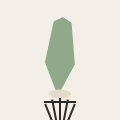
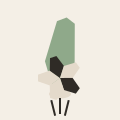
Batch started 4 August 2026; 24 samples, 82% success.
Four things to take away
- Take leaves from the second and third rings — outer leaves have less stored starch.
- All four failures traced to a torn petiole; a clean base calluses in 3–5 days.
- Do not water before roots appear — 21 days dry is correct.
- 82 % success over 24 leaves, with pups on 17 of the 20 that rooted.
Informational only — This page is a cultivation record, not horticultural or plant-pathology advice. Any treatment should follow the product label and local regulation.